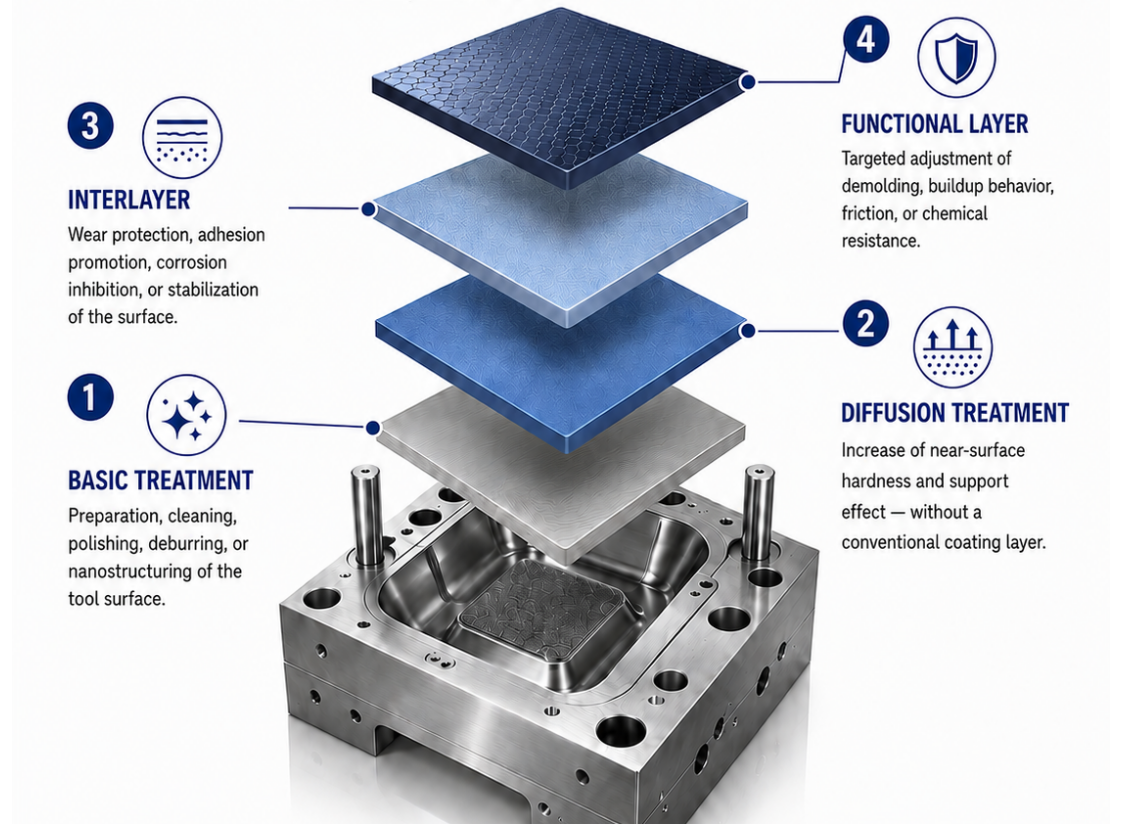
Material foundation
Tool steel and its near-surface zone provide the load-bearing foundation.

At a glance
Tool steel and its near-surface zone provide the load-bearing foundation.
Structure and surface energy influence contact, demoulding and deposit formation.
Interlayers and functional coatings are added only when the application requires them.
The choice of a single treatment or a combination depends on the plastic, geometry and loading.
The surface toolkit
The components are selected to suit the plastic, geometry and loading. Not every application needs every layer.
Principle & application
The surface of an injection mould is much more than its final machined contour. As the interface between steel and plastic, it influences how stable, economical and reproducible the process is.
Demoulding forces, deposit formation, wear, corrosion, visual part quality, maintenance intervals and the process window are directly related to the condition of the surface. Even changes at the micro- and nanoscale can determine process reliability and the need for rework.
Additives, flame retardants, fillers, glass fibres and UV stabilisers, as well as requirements for transparency or chemical resistance, change the interaction between plastic and the mould surface.
Stronger adhesion, faster deposit formation, increasing demoulding forces and visual deviations become particularly critical for high-gloss surfaces, tight tolerances, multi-cavity moulds and sensitive applications.
Gloss & Coating considers every application individually. The decisive factor is the function the surface needs to perform in the mould, rather than which standard coating is available.
Analysis, targeted selection and a combination of treatment and coating create a surface that supports demoulding, service life, maintenance and part quality.
Material, surface structure, hardness, friction behaviour and the functional layer are considered as a system. Depending on the problem, a single treatment may be sufficient, or a coordinated process chain can be used.
Existing moulds can be optimised retrospectively, while new moulds can be prepared for their required function during the design stage. A wear-resistant foundation, adapted topography and a functional layer can be combined in a targeted way.
Tool material, surface structure, hardness, friction behaviour and the functional layer are considered as a system. Depending on the application, a single component may suffice, or a coordinated process chain can be used.
Tool steel and its near-surface zone provide the load-bearing foundation.
Structure and surface energy influence contact, demoulding and deposit formation.
Interlayers and functional coatings are added only when the application requires them.
The right combination for the plastic, geometry, tool material and production process is decisive – from a single treatment to a coordinated process chain.
Selection depends on the plastic, tool material, geometry, temperature, mechanical loading, cleaning conditions and desired function.
Your application
The mould component, plastic and challenge are the starting point for our joint assessment.