Improve demoulding
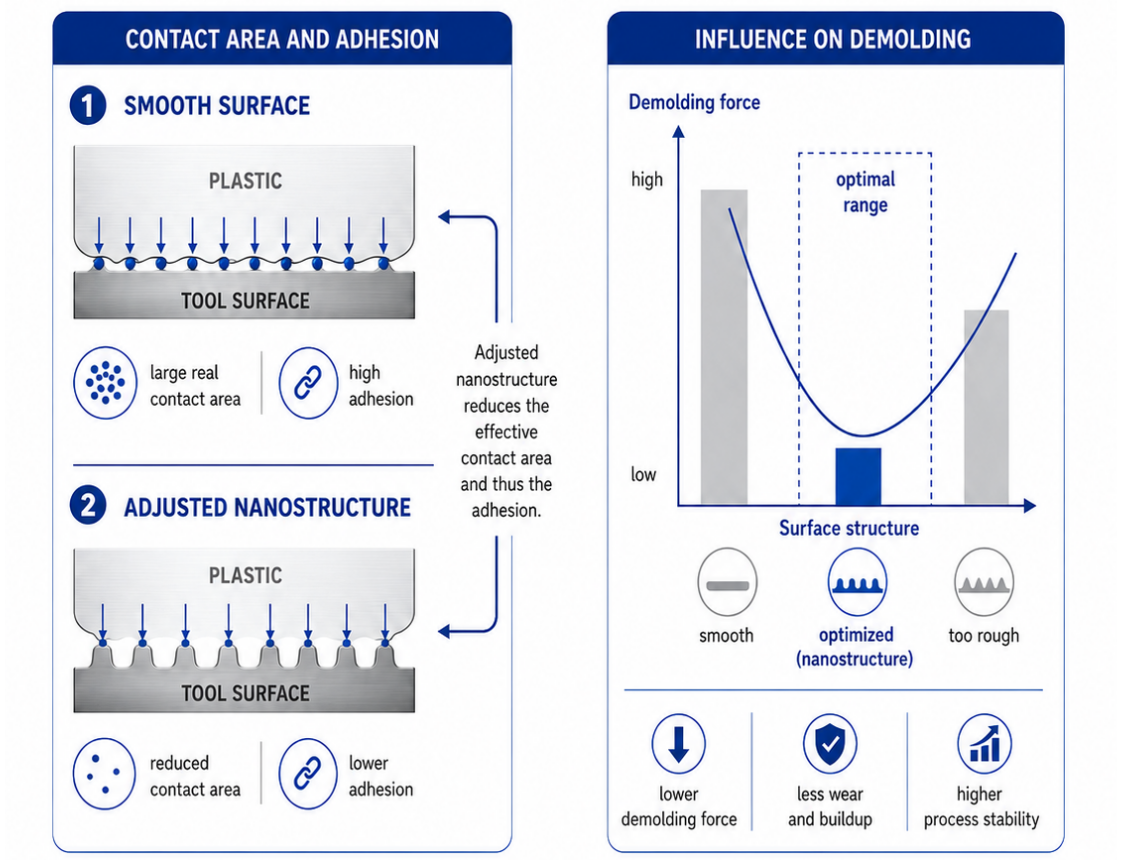
An adapted topography can reduce the effective contact area between plastic and steel.

At a glance
An adapted topography can reduce the effective contact area between plastic and steel.
The micro- and nanostructure are adapted to the combination of material and process.
The chemical composition of the mould surface remains unchanged.
Variants for parts with sensitive optical requirements are also possible.
Principle & application
With very smooth or highly uniform surfaces, the actual contact area between plastic and steel can be particularly large. Adhesive forces increase, making demoulding more difficult.
An adapted topography at the micro- and nanoscale reduces the effective contact area and can therefore influence demoulding, deposit formation and process stability without changing the part geometry.
Nanostructuring mechanically changes the finest surface structure. No additional coating is applied; the chemical composition of the mould surface remains unchanged.
This is particularly relevant where coatings are a concern or regulatory requirements play a role. The structure is adjusted to the plastic, viscosity, geometry and optical requirements; variants suitable for high-gloss surfaces are possible.
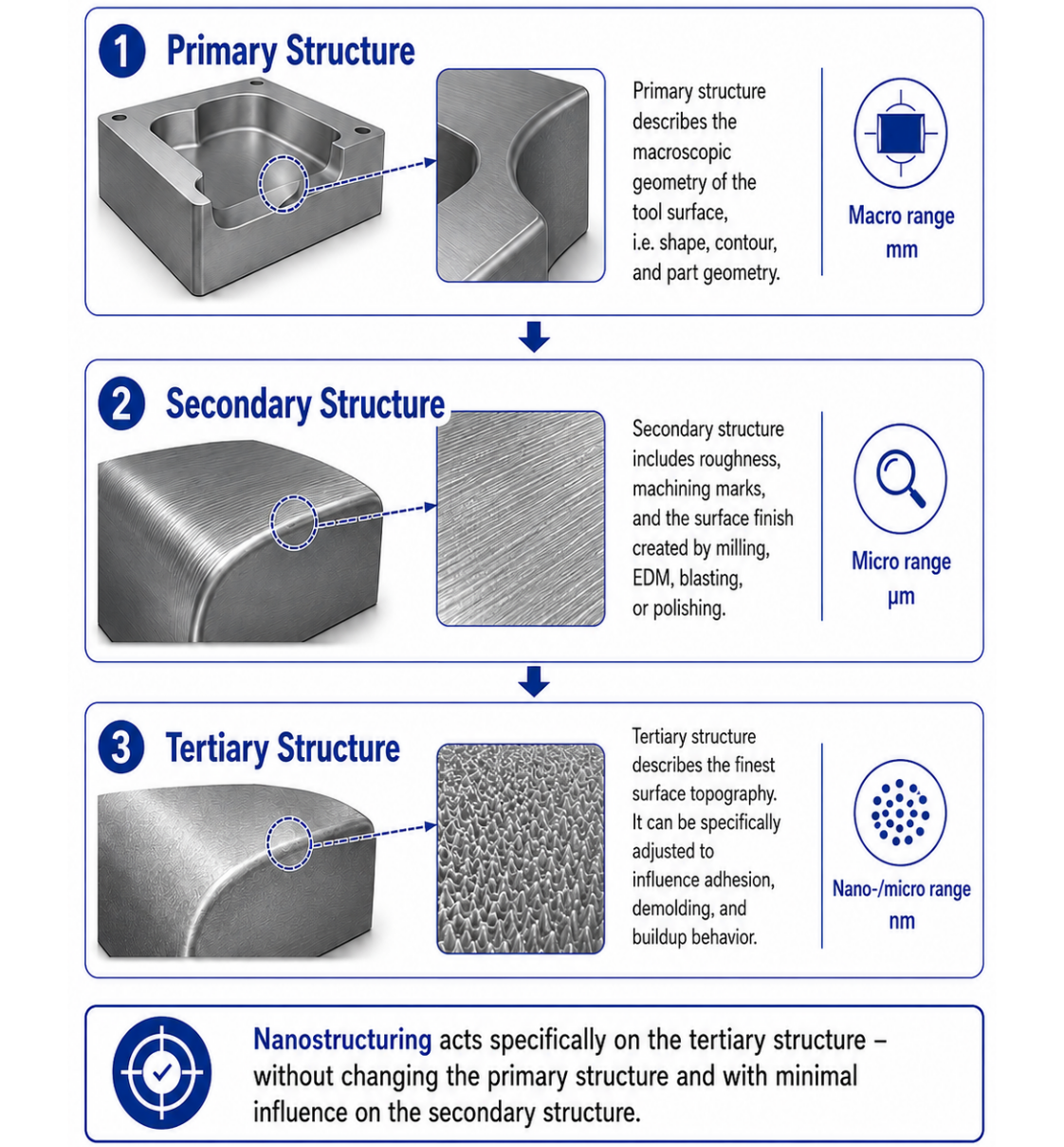
The primary structure describes shape, contour and part geometry at the macroscale. The secondary structure comprises roughness, machining marks and finish at the micrometre scale.
Nanostructuring specifically targets the tertiary structure. It influences adhesion, demoulding and deposit formation without changing the primary structure and with minimal influence on the secondary structure.
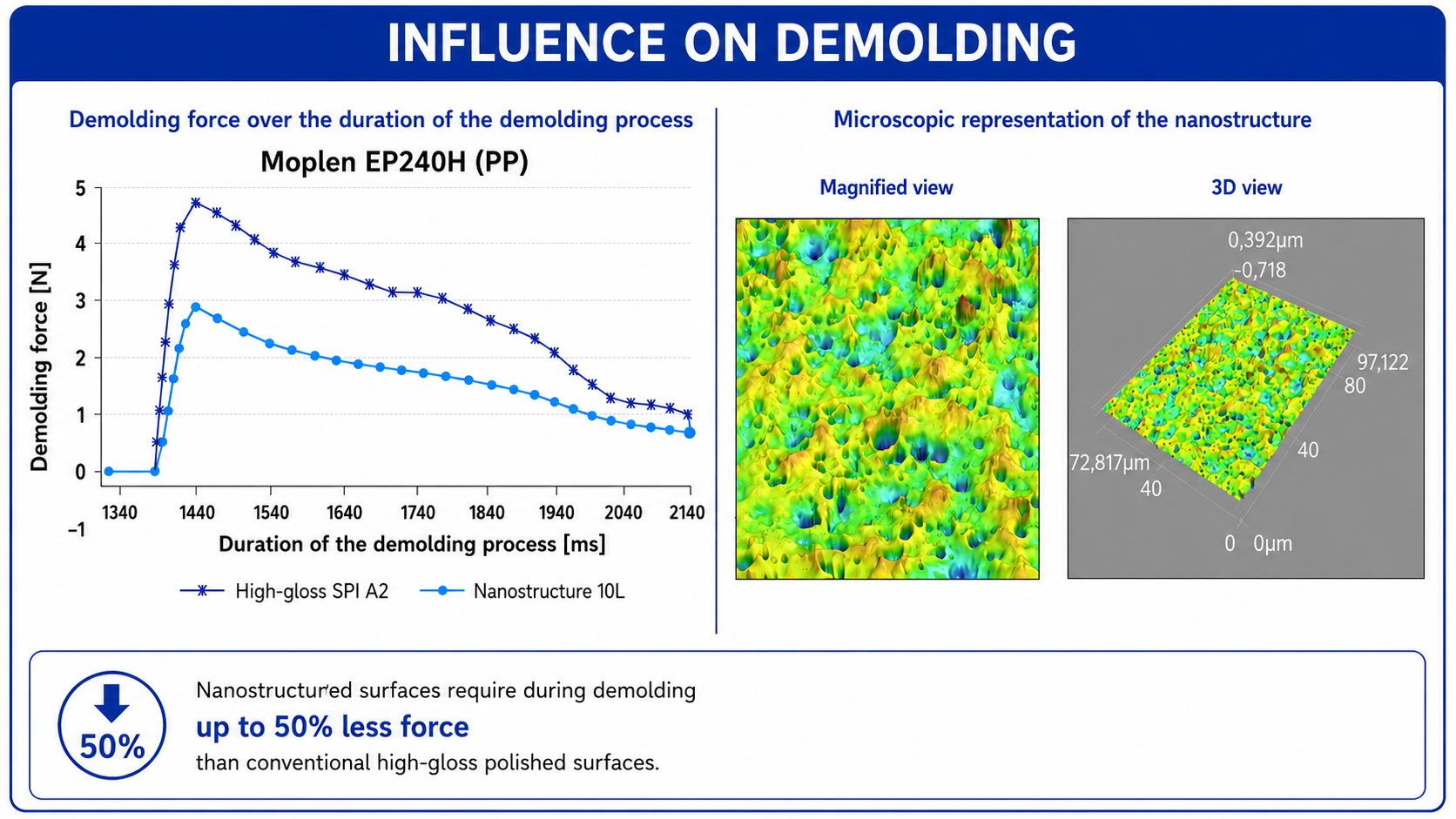
The measurement comparison between a high-gloss polished surface and nanostructure 10L shows a significantly lower demoulding force for the PP material tested, with a reduction of up to 50%.
Microscopic and three-dimensional views make the resulting surface topography visible.
Plastic and the mould form a direct interface. Its topography, surface energy and polarity influence how strongly the material adheres and how easily it can be demoulded.
The chemical composition of the mould surface remains unchanged.
The structure is selected with the plastic, viscosity, part geometry and optical requirements in mind.
Nanostructuring can be used on its own or to prepare for a thin functional coating.
Where adhesion, demoulding or deposit formation are affected by the interaction between plastic and the mould surface. Variants suitable for high-gloss surfaces are possible where visual part quality needs to be maintained.
Selection depends on the plastic, tool material, geometry, temperature, mechanical loading, cleaning conditions and desired function.
Your application
The mould component, plastic and challenge are the starting point for our joint assessment.